Category: !News & Press

  • Employee Appreciation Day and Social Work Month

    Employee Appreciation Day and Social Work Month

    Employee Appreciation Day was earlier this month, and there’s no way we can resist shouting out our wonderful employees in our newsletter! In particular, we want to recognize the contributions of social workers, who are also recognized in March through the celebration of Social Work Month.

    Social workers uplift their communities and defend the vulnerable, working in many fields such as schools, government, and health care. They attempt to help people work through the issues of everyday life, such as mental health, addiction, employment and housing. Many social workers work long hours to protect members of our society who are vulnerable or marginalized.

    The profession continues to draw more selfless individuals, with more than 810,000 social workers currently improving their communities today. Please join us in thanking any social workers in your life for the selfless work they do and join the National Association of Social Workers in spreading the word about Social Workers Month!

  • Daylight Savings and Enjoying the Outdoors

    Daylight Savings and Enjoying the Outdoors

    It’s finally time! Daylight savings time started on Sunday, March 8th, and we now have an extra hour of daylight. We’re excited for the warm weather so we can enjoy later sunsets and more time outdoors! Before we get into that, though, it is important to mention how important sleep is for your health, and how you and your loved ones can avoid daylight savings time getting the jump on you.

    Losing even an hour of sleep can affect your body, increasing stress hormones and putting additional strain on your heart. In the first week of daylight saving, many experts recommend getting to bed a half-hour earlier than normal and avoiding alcohol to help your body while it adjusts to the new rhythm.

    Now that we’ve cleared that, we can get into the fun part—enjoying that extra hour of sunshine! There are more ways to have fun in the sun than there are hours in the day, but we’ll give you some examples below to get your brain going!

    1. Birdwatching
      Birdwatching is a favorite pastime for people no matter what time of year it is, but it’s hard to argue that it isn’t more fun when the sun’s out! It gets you out in nature, brings you together with other enthusiasts, and a new study even suggests that practicing the skills used for birdwatching can improve your brain health!
    2. Gardening
      Gardening is a natural and rewarding way to improve your balance and flexibility; what’s more, if all goes well, you can even get some tasty veggies out of it! Whether you want to create a beautiful flower garden or your own grocery, gardening is a great way to stay attentive, productive, and active.
    3. Spending Time in a Park
      For an activity that doesn’t require any special gear or preparation, consider going to a park with your loved one! March 30th is Take a Walk in the Park Day, and who are we to argue with tradition? You can get some light exercise walking the paths or just sit on a bench and read a book. You could even bring a picnic basket with you for an idyllic brunch!

    We hope this blog has given you some ideas for how to spend that extra hour of sunshine! Enjoy the warmer weather, make sure you keep up with your sleep, and stay safe out there!

  • Women’s History Month – Florence Nightingale

    Women’s History Month – Florence Nightingale

    March is Women’s History Month, a time to recognize the contributions of women worldwide to history and progress. In the field of healthcare, there is perhaps no woman more famous for her influence than Florence Nightingale, often known as “The Lady with the Lamp.” Florence Nightingale organized and advanced care and nursing science, bringing the knowledge she learned as a nurse during the Crimean War back to London.

    Working as a nurse in Turkey in 1854, Nightingale was confronted with medicine shortages, mass infections, and an absence of good hygiene practices. For every one soldier killed in combat, ten would die from illnesses and infections, many of them preventable.

    Nightingale implemented improvements in hygiene practices (such as handwashing!) in the hospitals where she worked, with some claiming she turned a death rate of 42% to only 2%. She also petitioned publications in Britain to pressure the government for better conditions, to which the government responded with shipments of food, medicine, and an entire prefabricated hospital designed to be assembled upon delivery. Her presence caring for the wounded in this hospital even into the night earned her the nickname, “The Lady with the Lamp.”

    After the war, with the attention she’d gained from her success in improving healthcare conditions abroad, Nightingale was able to establish the Nightingale Fund and set up the first nursing school, called the Nightingale Training School, which is training nurses to this day. She released books on nursing written in plain English, introducing the public to methods of care and hygiene and making nursing much more accessible; because of these accomplishments, Nightingale is considered the founder of modern nursing.

    This Women’s History Month, let’s remember Florence Nightingale, the nurses who served with her, and every woman in healthcare, including many of our own Caregivers, that have worked to save and improve the lives of those in need.

  • Life in the Day: Maytal Allen

    Life in the Day: Maytal Allen

    My name is Maytal Allen, and I am a Home Care Specialist with Capital City Nurses in Howard County, Maryland.

    What does a day in my life look like? Sounds like a simple question, but the truth is, no two days are ever the same — and that’s one of the things I love most about what I do. Every day brings new conversations, new relationships, and new opportunities to show up for someone who needs support.

    If you had told me ten years ago that this is where I would be, I probably wouldn’t have believed you. I’m an Occupational Therapist by training, and I started my career in hospital settings — acute and subacute care. I worked with patients navigating complex diagnoses and major life changes. What mattered most to me then, and still matters now, was helping people regain their independence and improve their quality of life.

    Independence is deeply personal to me. I live with a disability, and from a young age, I made a promise to myself that it would not define or limit my life. But over time, I’ve learned something even more important: independence doesn’t mean doing everything alone. Sometimes it means accepting help. Sometimes it means allowing support so you can live safely and fully. That perspective has shaped not only my career, but the way I connect with families.

    After COVID, I felt a shift. I had seen too many patients return to the hospital simply because they didn’t have the right support at home. When I found Capital City Nurses, something clicked. Supporting people in their homes — helping them remain safe, comfortable, and independent — felt aligned with everything I believe in.

    My mornings start with my most important role: being a mom to my energetic two-year-old son. Mornings are full of playtime, getting ready for the day, and breakfast with my husband before we both head into our day. Then I transition into work — checking emails, calling families, reviewing my schedule. From there, I’m on the road visiting clients, meeting families, connecting with hospital teams, rehab centers, senior living communities — building relationships and being a resource.

    My days are busy, sometimes unpredictable, and rarely “perfect.” I’ve learned to be flexible and to problem-solve quickly. But what stays consistent are the people. I love speaking with families who feel overwhelmed and being able to offer reassurance. I love hearing the relief in someone’s voice when they know their loved one is safe at home. And I truly love meeting our Caregivers — seeing their compassion and dedication reminds me every day why this work matters.

    At the end of the day, I come home and step back into my favorite title — Mom.

    Looking back, this path makes so much sense to me now. It blends my professional training, my personal experiences, and my heart for helping others. I’m incredibly grateful to be where I am. I love what I do, and I’m proud to stand behind work that helps people live fuller, safer, and more independent lives.

  • Olivia Jones: Woman of Impact

    Olivia Jones: Woman of Impact

    Through our relationship with the American Heart Association (AHA), Care Advantage, Inc. has been able to contribute to the causes of fighting heart disease and researching heart health, donating more than $30K just last year. This year, our Executive Vice President, Olivia Jones, has been nominated as a “Woman of Impact.” Every year, the American Heart Association nominates changemakers to raise awareness and funds for women’s heart health research, with the person making the greatest local impact being named Woman of Impact in her city.

    Olivia is one of those changemakers, and she has a personal relationship with heart health. “My journey with the American Heart Association began long before my nomination; it began in a hospital room when my son was born with a congenital heart defect,” Olivia says. “Experiencing the fear, faith, and fight that come with an unexpected diagnosis changed me forever. It opened my eyes not only to how fragile life is, but also to the power of awareness, advocacy, and early intervention. Being a Woman of Impact means standing together for the women we love, the families we serve, and the hearts that still need healing, including my own family’s.”

    Fundraising for the Woman of Impact competition began on February 6th, which was marked by AHA’s Wear Red Day. Employees and people across the region wore the bright color in support of women’s cardiovascular health. Although Wear Red Day has passed, you can still support the efforts of the American Heart Association in a variety of meaningful ways. Follow this link to learn more about the Woman of Impact campaign: https://www2.heart.org/site/TR/?fr_id=12854&pg=entry. If you’d like to support Olivia’s efforts, click here.

  • Care Advantage, Inc. Acquires Neighborly Home Care’s Delaware Locations

    Care Advantage, Inc. Acquires Neighborly Home Care’s Delaware Locations

    Care Advantage, Inc. (“Care Advantage”), one of the largest privately owned home care companies in the Mid-Atlantic, announced today that it has completed the acquisition of Neighborly Home Care’s Wilmington and Georgetown, Delaware locations. Neighborly Home Care will retain its Ardmore, Pennsylvania location.

     The addition of Neighborly Home Care strengthens Care Advantage’s growing regional footprint across the Mid-Atlantic. The partnership advances the company’s mission to expand access to compassionate, high-quality, in-home care that enables individuals to live safely and comfortably at home. The transaction reinforces Care Advantage’s ongoing commitment to growth through strategic expansion across the Mid-Atlantic and Southeast. Financial terms were not disclosed.

     “Neighborly Home Care has built a deeply respected presence in Delaware, grounded in a commitment to reliability, compassion, and doing what’s right for the families they serve,” said David Wagnon, CEO of Care Advantage. “Their focus on high‑quality, compassionate care and their strong community relationships make them an exceptional fit for our organization. We are excited to welcome the Neighborly team and support their continued growth as we expand our services across the region.”

     “I’ve had many conversations over the years with various potential buyers, but Care Advantage is the first company that understands the value of our team working in Delaware,” said Rhod Rhen, CEO of Neighborly Home Care. “Because Care Advantage knows how important our people are, I feel confident that their approach will best preserve the culture that has been so instrumental to our success.”

     About Care Advantage

    Care Advantage, Inc. was founded in 1988 and provides in-home care services by trained and licensed Professional Caregivers to ensure patients remain safe, healthy, and happy in their home environments. Each patient’s care plan is tailor-made to suit their specific needs, concentrating on assistance with Activities of Daily Living (ADL’s). Core service areas include personal care, household help, and companionship. Corporate headquarters are in Richmond, VA and there are over 30 office locations throughout Virginia, North Carolina, Maryland, Delaware, South Carolina, and Washington D.C. To learn more about our mission to lift-up every community we serve, visit www.careadvantageinc.com.

     About Neighborly Home Care

    Neighborly Home Care is a full‑service, non‑medical home care agency providing in‑home services to seniors, adults with disabilities, and individuals needing support in Southeastern Pennsylvania. Founded by Rod Rhen, Neighborly is known for its selective Caregiver hiring process and creating customized care plans that prioritize safety, independence, and dignity. Neighborly offers senior care, disability care, respite care, live‑in support, transportation assistance, and recovery companionship.

     Contact

    For any inquiries, please contact Shreyas Kataria, Chief Development Officer at [email protected] or 804-356-7804.


  • Care Advantage Announces Acquisition of Attentive Angels Home Care

    Care Advantage Announces Acquisition of Attentive Angels Home Care

    Care Advantage, Inc. (“Care Advantage”), one of the largest privately owned home care companies in the Atlantic Mid-South, announced today that it has completed the acquisition of Attentive Angels, a leading provider of in-home care services based in Columbia, South Carolina.

    The addition of Attentive Angels marks Care Advantage’s entry into South Carolina and strengthens its growing regional footprint. The partnership advances the company’s mission to expand access to compassionate, high-quality, in-home care that enables individuals to live safely and comfortably at home. The transaction reinforces Care Advantage’s ongoing commitment to growth through strategic expansion across the Atlantic Mid-South and Southeast. Financial terms were not disclosed.

    “We are thrilled to welcome Attentive Angels Home Care into the Care Advantage family,” said David Wagnon, CEO of Care Advantage. “This partnership represents an exciting milestone as we extend our footprint into South Carolina—a market where we see tremendous opportunity to serve more individuals and families with the same quality and compassion that define our mission. Attentive Angels has built an outstanding reputation for care, and we look forward to building on their success as we continue our strategic growth across the region.”

    “Building Attentive Angels has been one of the greatest honors of my life,” said Davette Brown, RN, Founder of Attentive Angels. “After ten years of serving our community with trust, compassion, and excellence, we are proud to join the Care Advantage family. Their values align perfectly with ours, and we are confident that our clients, caregivers, and employees will continue to thrive under their leadership. This next chapter ensures that the legacy of care we’ve built will grow even stronger.”

    About Care Advantage

    Care Advantage, Inc. was founded in 1988 and provides in-home healthcare services by trained and licensed Professional Caregivers to ensure patients remain safe, healthy, and happy in their home environments. Each patient’s care plan is tailor-made to suit their specific needs, concentrating on assistance with Activities of Daily Living (ADL’s). Core service areas include personal care (bathing, grooming, dressing, toileting), household help (meal prep, laundry, light-housekeeping), and companionship (conversation and company, emotional support, socialization). Corporate headquarters are in Richmond, VA and there are over 35 office locations throughout Virginia, North Carolina, Maryland, Delaware, and Washington D.C. To learn more about our mission to lift-up every community we serve, visit www.careadvantageinc.com.

    About Attentive Angels

    Attentive Angels Home Care is a full-service, non-medical home care agency based in Columbia, South Carolina. The company offers in-home care services to seniors, individuals with cognitive disabilities, and those recovering from surgery. The company was founded and privately operated by registered nurse Davette Brown, who emphasizes dignity, respect, and holistic support through thoroughly screened Certified Nurse Aides and Personal Care Assistants. The company serves Richland, Lexington, Fairfield, Sumter, Kershaw, Clarendon, and surrounding counties.

    Contact

    For any inquiries, please contact Shreyas Kataria, Chief Development Officer at [email protected] or 8043567804.

  • Tim Hanold, CEO: Chair for BMAS

    Tim Hanold, CEO: Chair for BMAS

    Since joining Care Advantage, Inc. our CEO, Tim Hanold has been steadfast in his commitment to population health and ensuring that all those who need care receive it in the communities we serve.

    Last month, Tim took on his new role as Chairman of the Board of Medical Assistance Services in Virginia. He explained how proud, passionate, and excited he was about his new position.

    “I am delighted and honored to take on this role. The opportunity to collaborate with other industry leaders, gather insights from different perspectives, and tap into their expertise is a process I value greatly. As a collective, we are committed to improving the health and well-being of Virginians through access to high-quality health care coverage and services. I look forward to forming closer relationships with my peers and partner organizations to continue to bring a person-centered healthcare experience to the people of Virginia.”

  • Care Advantage, Inc. Extends Northern Virginia Footprint

    Care Advantage, Inc. Extends Northern Virginia Footprint

    Care Advantage, Inc. Grows with the Acquisition of Nova Home Health Care

    Care Advantage, Inc., the largest privately owned home health company in the Atlantic Mid-South, completed the acquisition of Nova Home Health Care in Northern Virginia earlier today.

    Nova Home Health Care will be the twentieth acquisition Care Advantage, Inc. (CAI) has completed since 2018, and the eighth since joining forces with Searchlight Capital Partners in 2021. Through this addition to its care family, Care Advantage, Inc. demonstrates its dedication to expanding the scope and breadth of care services on offer. Nova Home Health Care’s team of over 200 caregivers provides compassionate, innovative, and personalized care, and will only continue to grow in the Care Advantage family of brands.

    Tim Hanold, CEO of Care Advantage, said, “Formalizing the union of Care Advantage and Nova Home Health Care has been something I have been looking forward to for quite some time. Even from our earliest conversations, it was very clear how important their clients are to them. The passion and enthusiasm they put into their care felt familiar and affirming tome and the CAI team. Adding Nova Home Health Care to our Care Family alongside legacy brands such as Capital City Nurses, Care Advantage, Youngs Home Health and National Home Health is extremely exciting.”

    Ali Abdi, CEO of Nova Home Health Care, said, “This partnership with Care Advantage positions us with the tools and resources to take our service offering to the next level. Care Advantage’s culture feltlike a good fit from the beginning—we both bring the same type of care and compassion to the table. I know this is the right direction for Nova Home Health Care, and I can’t tell you how enthusiastic I am to see where this takes us.”

    Samad Deef, CFO of Nova Home Health Care, added, “The thing I’m most excited about is the experience of Care Advantage. This is a company with a solid track record integrating companies like ours in northern Virginia. It was important to us to partner with a brand that knew how to handle mergers like this, and we have found that partner in Care Advantage. This team excites me because it represents the next step for Nova Home Health Care—a step we’re excited to take with all our clients.”

    About Care Advantage

    Care Advantage is the Atlantic Mid-South’s leading privately held home healthcare provider. The Company specializes in “one-on-one” quality nursing care in the home and is a one-stop shop for home healthcare services. Corporate headquarters are in Richmond, VA and there are 51 branch locations throughout Virginia, Maryland, Delaware, North Carolina, and Washington D.C. The Company provides a mix of Medicaid and self-pay nursing and personal care services such as bathing, dressing, and companionship and provides skilled services primarily by licensed nurses and therapists.

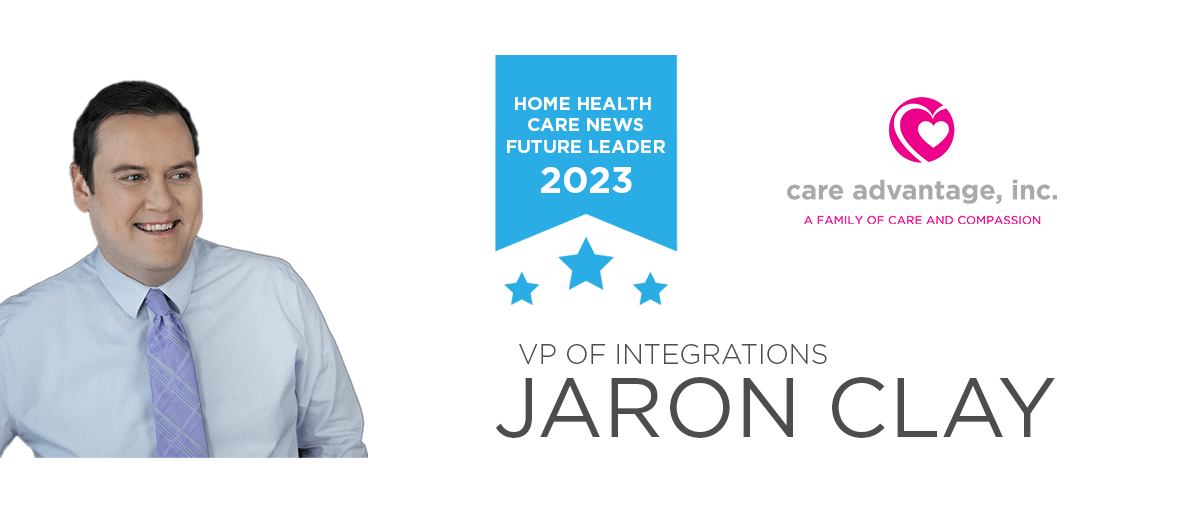
  • Jaron Clay, VP of Integrations, Awarded Future Leader by Home Health Care News

    Jaron Clay, VP of Integrations, Awarded Future Leader by Home Health Care News

    This article was originally written by Patrick Filbin for Home Health Care News. To read the original article, click here.

    The Future Leaders Awards program is brought to you in partnership with Homecare Homebase. The program is designed to recognize up-and-coming industry members who are shaping the next decade of home health, hospice care, senior housing, skilled nursing, and behavioral health. To see this year’s Future Leaders, visit https://futureleaders.agingmedia.com/.

    Jaron Clay, the vice president of integrations at Care Advantage, has been named a 2023 Future Leader by Home Health Care News.

    To become a Future Leader, an individual is nominated by their peers. The candidate must be a high-performing employee who is 40-years-old or younger, a passionate worker who knows how to put vision into action, and an advocate for seniors, and the committed professionals who ensure their well-being.

    Clay sat down with HHCN to talk about the importance of caregiver satisfaction, educating communities on the accessibility to home care, the rising influence of value-based arrangements and more.

    HHCN: What drew you to this industry?

    Clay: Like so many other folks, I got into this with a strong desire to help other people. The first job I ever had in this industry was managing group homes for adults with intellectual disabilities. I got into that right at a time when the Commonwealth of Virginia was making a giant push to get individuals out of state-run institutional care and back into residences in the communities that they were from.

    That was really such an exciting time to be doing that and it was really edifying to see the improvements that people would make just being at a home that they could call their own. There’s a sense of dignity that was given to them because of that. And for me, the light just went on. I saw the improvements people made and I was hooked. I’ve been an evangelist for care in the home ever since then, because I’ve really seen firsthand how it helps folks.

    What’s your biggest lesson learned since starting to work in this industry?

    I always need to ask myself and ask other leaders around me, whenever we’re making a decision, “How is this going to impact our caregivers?”

    Every agency out there has their clients front and center, as they should be, but our caregivers play such an important part of our care ecosystem. It’s important to remember they have options. They can opt out of this. Our sick or elderly folks can’t just snap their fingers and decide not to be that one day, but our direct care professionals can decide that they want to go do something else. They have options.

    I think it’s very important to think about how important the work is that our direct care professionals do, how hard it is, the sacrifices they make to make other families better. It’s almost philanthropic on their part.

    I think it’s important to always acknowledge that and to ask ourselves when we’re making decisions, how is this going to impact our care professionals? Are the actions we’re making at the company showing up to be their champions — because the entire care delivery system doesn’t rest on executives, it rests on the labor of those folks.

    If you could change one thing with an eye toward the future of home-based care, what would it be?

    Lowering the barrier to entry to care and making the learning curve a little easier.

    I serve on the board for the city of Richmond’s Office of Aging and Disability Services. Every time we have a meeting, it’s just staggering the reports of the number of people who call in, they need care, they need help, they’ve paid into programs their entire life and they have no idea what they’re entitled to. They have no idea what help is actually out there for them.

    The approval process is very, very hard for many of our elderly folks to navigate on their own. And that’s just heartbreaking. I think we need to better educate our communities as to who we are as an industry and what sort of services they have and how they can access that because, for so many of these folks, care can’t wait 30 or 60 days while they try to figure this out on their own.

    What do you foresee as being different about the industry looking ahead to 2024?

    Especially in light of the CMS access rule, I think more and more providers are going to understand that value-based reimbursement has to be part of their solution set and their revenue stream. It’s going to be an important differentiator for themselves versus other organizations down the road.

    I think that has the potential to be really, really good for our consumers. That additional scrutiny on the value that companies are providing. Are they really keeping their clients from rehospitalization? I think that’s going to really create a healthy competition among providers to be really, truly excellent at service delivery. If that is the case, then our consumers are definitely going to benefit from that.

    In a word, how would you describe the future of home-based care?

    I hope it’s growing. The company I work for and the other companies that I’m acquainted with, so many of us are at our bandwidth when it comes to the number of caregivers we have versus the number of people needing care. Over the next 10 or 15 years, particularly as the baby boomers continue to age, those needs are only going to go up.

    So as an industry, we need to continue to grow to meet that need or we’re going to have a lot of folks who need care that isn’t available to them.

    I also think we need to find new ways to encourage more people to move into caregiving. We have to be the advocates for adequate reimbursement so that caregiving is an appealing job that’s compensated at the level it should be. If we fail to do that, we’re going to miss out on an opportunity to help so many who are going to need care at some point down the road.

    What quality do you believe all future leaders must possess?

    I think that they have to possess the ability to be nimble and to not be beholden to the way home care was done 20 years ago.

    The industry is changing every day. I’ve seen it in just my first decade in the industry. We’ve had to tear up our game plan and create new ones in response to that. Anyone who wants to be a leader in this industry has to be really willing to be adjustable and to be nimble and to try out new things.

    And not be afraid to fail fast. Because that’s going to be the only way we come up with innovation and better care for our clients.

    To learn more about the Future Leaders program, visit https://futureleaders.agingmedia.com/.