

Alzheimer’s Home Care
Dementia is a general term for the progressive loss of memory, language, reasoning, and problem-solving abilities severe enough to interfere with daily life. Alzheimer’s disease is the most common cause, accounting for 60–80% of cases. Other forms include vascular dementia, Lewy body dementia, and frontotemporal dementia.
All Care Advantage, Inc. brands provide specialized, in-home dementia and Alzheimer’s care across Virginia, Maryland, Washington D.C., and Delaware. Our trained Caregivers — supported by a full Care Team of registered nurses, care coordinators, and supervisors — deliver compassionate, personalized memory care services designed to help individuals live safely and with dignity in the place they know best: home.
Recognizing the Early Signs of Dementia
Understanding the early signs of dementia is the first step toward accessing the right memory care services at the right time. Early signs can vary from person to person, but common indicators include:
- Getting lost in a familiar neighborhood — A routine walk or a well-known drive to the store suddenly becomes disorienting or confusing.
- Using unusual words for familiar objects — Pausing during everyday conversation to search for common vocabulary.
- Forgetting the names of close family members or friends — Struggling to recall the names of people who matter most.
- Losing touch with long-held memories — Forgetting family milestones, personal history, or meaningful events.
- Difficulty completing familiar tasks — Once-simple routines like making coffee, managing laundry, or organizing the mail become hard to manage independently.
Witnessing these changes in a loved one is painful. The Centers for Disease Control and Prevention (CDC) recommends speaking with a healthcare provider at the first signs of dementia. An early diagnosis opens the door to treatment options, clinical trials, dementia Caregiver support programs, and memory care services — and allows your family time to plan ahead together.
Dementia Stages and Care
Dementia progresses through stages, and the type of care needed evolves with each one. Care Advantage supports individuals and families through every phase of this journey.
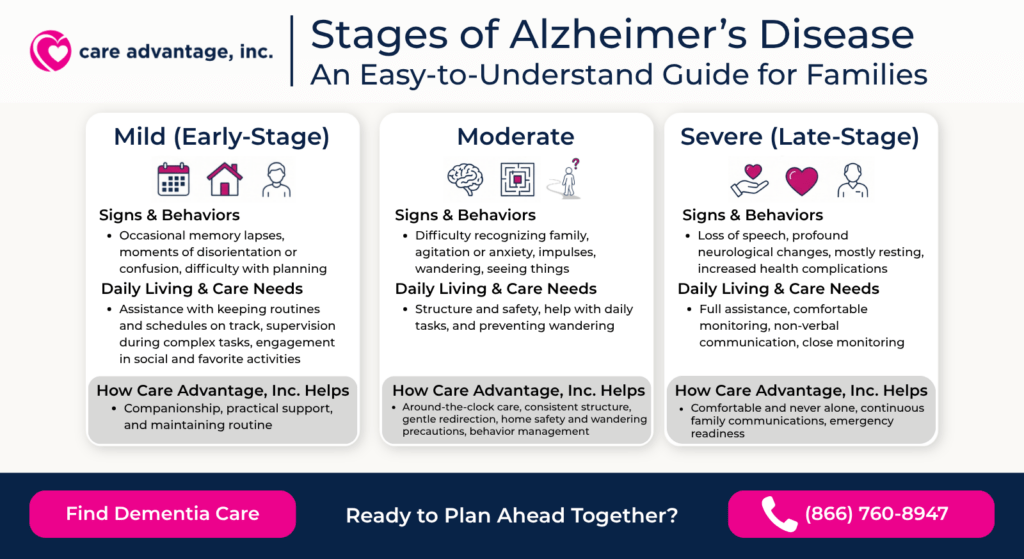
Mild (Early-Stage) Dementia
In the early stage, a person may live relatively independently while experiencing occasional memory lapses, moments of confusion, or difficulty with planning and organization. Care Advantage Caregivers provide companionship and practical support at this stage, helping individuals maintain their routines and stay engaged in the activities they love — while giving family members reassurance and a trusted partner in care.
Moderate Dementia
As dementia progresses, the disease begins to affect the areas of the brain that manage language, reasoning, and sensory processing. Daily life becomes more confusing. Familiar routines feel overwhelming. A person may struggle to recognize close family members, experience moments of agitation or anxiety, or act on sudden impulses. Some individuals begin to see or believe things that are not there.
At this stage, Care Advantage Caregivers step in with consistent, around-the-clock support — providing structure, safety, and calm companionship when the world feels unpredictable. Preventing wandering and managing dementia behaviors become central priorities, and our team is trained to respond with patience and skill.
Severe (Late-Stage) Dementia
In the severe stage, physical and neurological changes become profound. A person living with dementia at this stage will likely lose the ability to communicate with words, require full assistance with all daily care, and spend much of their time resting. Their body begins to slow, and they become increasingly vulnerable to infections and other health complications.
Care Advantage provides dignified, attentive care through this stage — ensuring that your loved one is comfortable, closely monitored, and never alone. Our Caregivers and clinical team stay in close communication with families, providing the support and peace of mind that matters most during this time.
How Care Advantage Supports Dementia Patients at Home
How to Care for Dementia Patients at Home
Caring for a person with dementia at home requires a thoughtful, individualized approach. Our Caregivers take time to learn each client’s unique history, routines, and preferences — because for someone living with memory loss, familiarity is everything. Care Advantage’s approach to in-home dementia patient care includes:
- Calm Companionship and Meaningful Engagement. We provide genuine friendship and activities tailored to what your loved one enjoys — whether that’s looking through old photo albums, listening to familiar music, tending to a garden, or sharing a favorite meal. Meaningful engagement supports cognitive health and emotional well-being.
- Routine-Based Support and Personal Care. Predictable routines reduce confusion and anxiety for individuals living with dementia. Our Caregivers help with bathing, dressing, grooming, and meals — always with respect for privacy and personal dignity.
- Gentle Redirection and Dementia Behavior Management. Agitation, repetitive questioning, sundowning, and anxiety are common dementia symptoms that can be challenging to navigate. Our Caregivers are trained to de-escalate with calm guidance and gentle redirection — easing distress before it grows.
- Brain-Healthy Meals and Physical Activity. Proper nutrition and gentle movement play a meaningful role in supporting cognitive function and mood. We assist with preparing brain-healthy meals and encourage light physical activity suited to each individual’s abilities and comfort.
- Home Safety and Wandering Precautions. We work with families to create a safer home environment — minimizing fall risks, securing potential hazards, and addressing wandering concerns with practical safeguards.
- Ongoing Observation and Emergency Readiness. Our Caregivers are trained to notice changes in health or behavior and act quickly when needs shift. We maintain open communication with families and our clinical team so nothing is missed.
Adapting Daily Activities for People Living with Dementia
As dementia progresses, favorite activities may become harder to enjoy in their original form — but they don’t have to disappear entirely. Activities can be adapted in home care for memory loss patients to make them simpler, safer, and more enjoyable:
- Match activities to the person’s current abilities
- Choose activities that can be shared together
- Offer gentle prompting to help them get started
- Watch for signs of frustration and step in before distress grows
- Focus on the experience and connection, not on the outcome
- Let them observe if participation feels like too much
Small moments of engagement and joy matter — and our Caregivers are skilled at finding them.
When Does a Dementia Patient Need Care?
The Alzheimer’s Association recognizes that dementia stages and care needs vary from person to person. Here is a general framework:
- Early Stage: Caregiving is focused on companionship, support with planning, and preparation for the future. Many individuals remain relatively independent with some oversight and assistance.
- Moderate Stage: According to the Alzheimer’s Association, it eventually becomes too difficult — or dangerous — for a person to be left alone. Preventing wandering is a crucial priority, and safety precautions must be taken throughout the living environment. This is often the stage when families begin exploring professional in-home care and respite options.
- Severe Stage: At this stage, individuals typically require around-the-clock assistance with all daily activities. They may lose awareness of their surroundings, experience changes in physical abilities, have difficulty communicating verbally, and become more vulnerable to infections. Full-time, skilled care becomes essential.
If you are uncertain whether now is the right time to seek help, our Care Team is available to guide you through the options — with no obligation and no pressure.
Dementia Caregiver Support
Caring for a loved one with dementia takes immense time, effort, and emotional energy. Family caregivers often experience stress, exhaustion, grief, and isolation — feelings that are completely valid and deeply human.
The National Institute on Aging recommends that Caregivers build strong coping skills, lean on a supportive network, and prioritize respite care. Even small steps — staying physically active, keeping up with friends, getting enough sleep — can make a meaningful difference in a Caregiver’s resilience and well-being.
Support Groups
For many Caregivers, support groups become a lifeline. Whether in-person or online, these communities offer a space to share concerns, exchange practical tips, and find comfort among people who truly understand what you are going through.
The GUIDE Program: Dementia Caregiver Support Through Medicare
The Guiding an Improved Dementia Experience (GUIDE) model, developed by the Centers for Medicare & Medicaid Services (CMS), provides essential dementia caregiver support for families navigating this journey.
Through the GUIDE program’s respite voucher system, eligible families can access up to 80 hours of respite care per year, schedulable in flexible 4-hour blocks. This gives caregivers the structured time off they need while ensuring their loved one continues receiving specialized dementia patient care in a safe, supported environment.
Who qualifies: The GUIDE program serves individuals experiencing cognitive decline or living with a formal dementia diagnosis who have traditional Medicare coverage. It specifically supports family members and friends managing the daily challenges of caregiving.
Program features include:
- Personalized care plans tailored to each individual’s needs
- 24/7 access to support and guidance
- Home safety education to reduce risk and give families peace of mind
Care Advantage works with families to navigate benefit programs like GUIDE, helping you access the support you’ve earned.
Find Dementia Care Near You
Care Advantage is here for every step of the dementia caregiving journey — from the first signs of memory loss to full-time support in the late stages of the disease. Our Caregivers bring not just skill, but genuine compassion, to every home they enter.
Alzheimer’s Home Care FAQs
Caring for someone with dementia at home begins with understanding their unique needs, routines, and history. Care Advantage Caregivers dedicate time to knowing each client as an individual — not just their diagnosis. We develop personalized coping strategies, provide consistent routines, and focus on daily well-being, safety, comfort, and connection. Our clinical team provides ongoing oversight and is always available to guide families through new challenges.
There is no single answer, but a general rule is: earlier is better. Even in the early stages, having a trusted Care Advantage Caregiver in place helps establish routine, provides companionship, and gives families time to prepare. As the disease progresses, the level of support naturally increases. Our team will work with you to calibrate care to where your loved one is right now — and adapt as their needs change over time.
Care Advantage provides specialized in-home dementia patient care across Virginia, Maryland, Washington D.C., and Delaware. Our local teams understand the communities they serve and are ready to match your loved one with the right Caregiver.
We understand that cost is a key consideration when selecting in-home care, and we are committed to making our memory care services both accessible and affordable. Payment options may include:
- Private pay
- Medicaid
- Long-term care insurance
- Veterans’ benefits
Our team is happy to walk you through the options and help identify the coverage available to your family.
While standard personal care assists with routine daily tasks, specialized Alzheimer’s care specifically addresses cognitive changes. Our Caregivers complete advanced training to support individuals through memory loss and behavioral shifts. We focus on creating structured environments, maintaining familiar routines, and utilizing gentle redirection techniques to promote emotional well-being. Additionally, your family does not have to choose just one type of support; our Caregivers provide a seamless blend of personal assistance, companionship, and household help all together.
Our Caregivers maintain calm environments and steady routines to reduce late-afternoon confusion and restlessness. To safeguard your loved one from wandering, we implement protective measures such as:
- Securing entryways and monitoring exit points.
- Engaging individuals in soothing physical activities earlier in the day.
- Using gentle verbal redirection when agitation or confusion arises.
- Installing helpful safeguards throughout the residence.
Yes, the Guiding an Improved Dementia Experience (GUIDE) model supports individuals living with Alzheimer’s Disease and their family caregivers. Qualifying traditional Medicare beneficiaries may receive up to 80 hours of annual respite care, giving family members time to rest while our compassionate Caregivers step in. Learn more about how this benefit supports families by visiting our GUIDE Program page.
Consistency builds comfort and trust for individuals with memory loss. We prioritize reliable Caregiver matching so your loved one builds a reassuring relationship with a familiar face who feels like part of your family.
Our trained Caregivers handle delicate situations with patience, validation, and calm communication. When resistance occurs, we avoid confrontation and instead:
- Step back to give your parent personal space.
- Redirect their focus toward an enjoyable activity or topic.
- Re-approach care tasks later when their mood improves.
- Partner with our supervisory team to adapt care strategies as needs change.
Yes, we provide dedicated support throughout every stage of cognitive decline. As needs evolve, our Caregivers shift focus to total comfort, continuous supervision, specialized mealtime assistance, and complete personal hygiene support so your loved one continues living life to the fullest.
We design meaningful, purpose-driven engagement tailored to personal life histories and current abilities. Daily activities include:
- Listening to favorite musical eras.
- Simple gardening or sorting activities.
- Looking through family photo albums.
- Guided sensory exercises and light walks.
We simplify meal times by maintaining consistent eating schedules, minimizing dining distractions, and presenting appetizing foods in easy-to-manage portions. Caregivers offer patient encouragement and physical assistance when necessary to ensure optimal hydration and nourishment.
When verbal communication diminishes, our Caregivers rely on reassuring non-verbal cues. We speak in clear, gentle tones, maintain warm eye contact, use supportive body language, and practice active, patient listening.
Yes, continuous in-home support allows individuals to remain safely in their familiar home setting much longer. By removing environmental hazards, managing medication schedules, preventing wander-related injuries, and assisting with daily tasks, we help delay or eliminate the need for residential facility placement. To make this care accessible, we offer flexible payment options, including Long-Term Care Insurance (LTCI), private pay, Medicaid, and VA Benefits.
We offer flexible respite care options, including scheduled relief shifts, hospice care support, and potential coverage through the Medicare GUIDE Program. Taking continuous caregiving breaks helps family members recharge, preserve their health, and focus on their personal relationship with their loved one.
Sources:
National Institute on Aging (NIH): · https://www.nia.nih.gov/health/alzheimers-and-dementia
U.S. Centers for Disease Control and Prevention (CDC): · https://www.cdc.gov/alzheimers-dementia/index.html
Alzheimer’s Association · https://www.alz.org
Centers for Medicare & Medicaid Services — GUIDE Program · https://www.cms.gov/priorities/innovation/innovation-models/guide
