

Most adult children do not set out to say the wrong thing to their elderly parents. It happens in a rushed moment, a worried conversation, or a situation where you are trying to help, and the words sometimes don’t come out the way you intended.
The problem is that certain phrases, even well-intentioned ones, can chip away at a parent’s sense of dignity and independence. Once that trust erodes, the conversations that matter get harder.
The Importance of Knowing How to Talk to Aging Parents
The relationship between adult children and their aging parents shifts in ways nobody really prepares you for. Somewhere along the way, you start worrying about them the way they once worried about you. That shift is natural, but it can change how you speak to your parents, in ways that feel helpful to you and dismissive to them.
Aging does not take away a person’s need to feel respected. If anything, it makes that need sharper. Parents who feel talked down to, rushed, or dismissed tend to pull back, resist help, and stop sharing what is going on in their lives.
8 Things Not to Say to Your Aging Parents
-
“You’re repeating yourself.”
They probably already know this. Pointing it out does not fix anything, and most of the time it just adds embarrassment to the moment. If memory changes are becoming a pattern worth addressing, that is a conversation to have with their doctor, not a comment to make mid-story.
-
“You shouldn’t be living alone anymore.”
This statement stings because independence is not just a practical matter for older adults. It is an identity. Telling someone they can no longer live alone, especially as a statement rather than a conversation, can feel like a verdict. Ask questions instead by learning how they are managing, what feels hard for them in their day-to-day, and what they enjoy about their home. The answer may surprise you!
-
“Let me just do that for you.”
It feels like help, but to them, it can feel like a quiet signal that you no longer trust them to manage their own life. What you can do is offer assistance, but do not assume it is needed. Saying something like, “Would it help if I took care of that?” is a different offer than just completely taking over.
-
“Give me your car keys.”
The driving conversation is one of the hardest moments that families face, and it rarely goes well when it is framed as a demand. A parent who feels ambushed might get defensive, and one who feels included in the decision is more likely to accept the change. To get the conversation going, take a casual family car ride together and ask how they feel about driving at night, or if they ever feel anxiety behind the wheel. And if needed, reach out to their doctor for additional help and resources.
-
“You already told me that.”
Similar to number one, this statement tends to embarrass your loved one without helping. If you have heard the story before, listen again and be engaged in the conversation. The point of the story was never the information; it was the connection.
-
“Why can’t you remember?”
Frustration is understandable, but expressing it in a hostile way is not useful. Memory changes are not a choice, and being asked to account for them is demoralizing. If memory loss is a real concern, bring it up calmly with compassion and a concrete next step.
-
“You’re acting like a child.”
This one is hard to come back from. Even if said in a moment of genuine frustration, it is the kind of comment that people tend to remember. It dismisses whatever they were feeling and reframes the entire interaction as a parent-child dynamic, with the roles reversed in the most hurtful way possible.
-
“You never listen to my advice.”
Framing any conversation as something your parent does wrong is going to make them defensive. If there is a real pattern you want to address, try starting from your own experience rather than their behavior.
What Can You Say Instead? Try These Compassionate Communication Strategies
The thread running through all the above is this: your parent wants to feel like a person who still has independence, not a problem being managed.
Ask open-ended questions. “How are you feeling about your living situation?” gets you further than “Are you okay living alone?” The first invites a real answer while the second invites a yes or no response.
Use “I” statements when something concerns you. “I’ve been thinking about you a lot and wanted to check in” is easier to receive than “You never call me back.” One expresses care, and the other assigns blame.
What else can you do? Try listening more than you talk. This sounds obvious, but it’s harder than you think, especially when you’re worried. Resist the urge to problem-solve in real time. Sometimes your parent needs to feel heard before they can hear you.
Older adults often process conversations more slowly because they weigh things carefully.
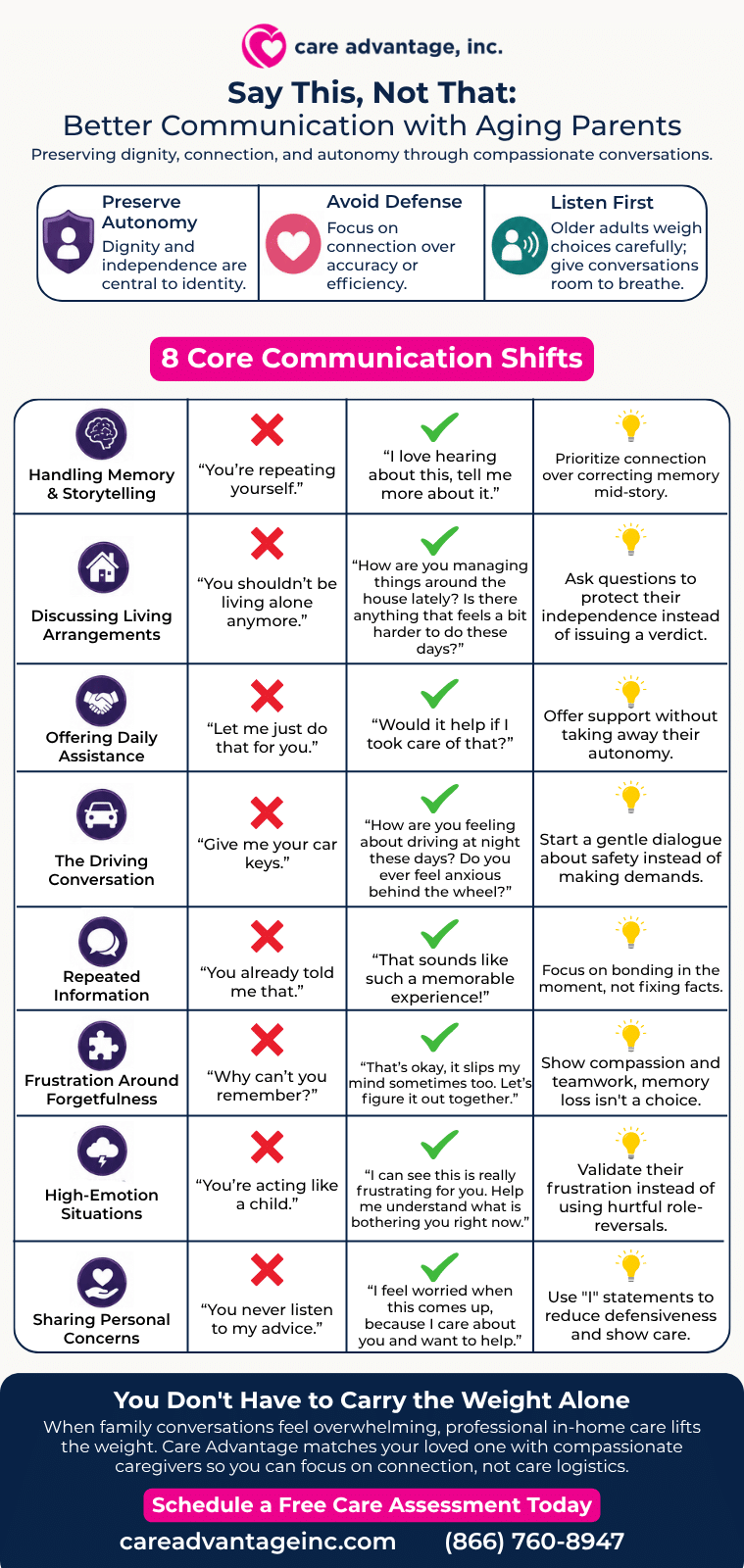
View & Download This Infographic as a PDF
When to Seek Professional Support from Care Advantage, Inc.
Sometimes the strain in these conversations is not really about the words. It is about everything underneath them: the fear, the exhaustion, the weight of trying to manage a parent’s care while managing everything else in your own life.
When family caregiving starts to feel more than you can carry alone, professional in-home care can take some of that weight off. At Care Advantage, Inc., our Caregivers handle the day-to-day support that keeps your loved one safe and comfortable at home, which means your time together can be less about logistics and more about your relationship.
We match each client with a Caregiver based on their needs, preferences, and personality. Our Caregivers are licensed, bonded, and insured, and they work alongside a clinical care team that includes registered nurses. If a Caregiver is ever unexpectedly unavailable, we arrange coverage quickly, so your family is not left without support.
When you are ready to talk through what compassionate care could look like for your family, we are here. Contact us for a free care assessment.
Source: Active Aging Daily, activeagingdaily.com.
